
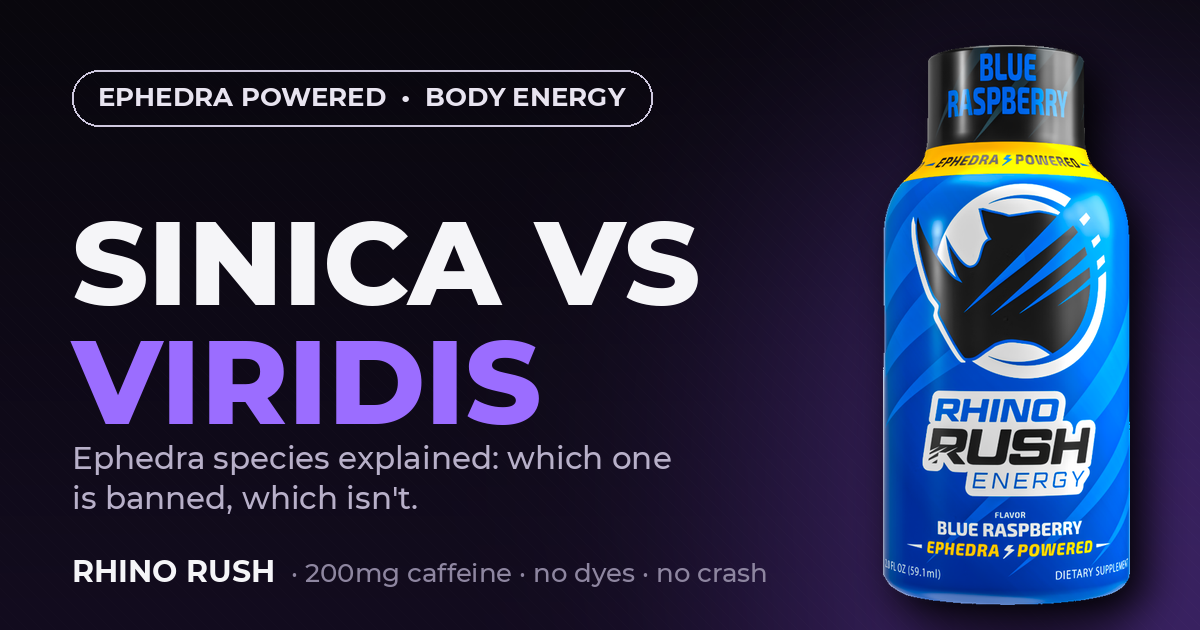
Ephedra is a genus of roughly 60 species of jointed, nearly leafless shrubs, and they are not chemically alike. Asian species like Ephedra sinica, known as ma huang, are rich in ephedrine alkaloids and were the source of the supplements the FDA banned in 2004. North American species like Ephedra viridis (Mormon tea) contain little or no ephedrine, which is why Rhino Rush uses Ephedra viridis in its Ephedra Powered energy shots.
Quick answer: The ephedra species that matters legally is Ephedra sinica (ma huang), an Asian shrub whose stems are high in ephedrine and pseudoephedrine. It's the plant behind the banned weight-loss supplements. North American species, including Ephedra viridis, Ephedra nevadensis, and Ephedra trifurca, have been found to contain little or no ephedrine, so they aren't the ephedrine-alkaloid supplements the FDA's 2004 rule covers.
How many species of ephedra are there?
Botanists recognize roughly 60 species in the genus Ephedra, the only genus in the family Ephedraceae. They grow in dry climates across Asia, the Mediterranean, North Africa, and the Americas. All share the same look: green, jointed, broom-like stems with tiny scale leaves. What they don't share is chemistry. Alkaloid content swings enormously from species to species, and that difference is what decides whether a product is banned. For the basics, start with what is ephedra.
What is Ephedra sinica (ma huang)?
Ephedra sinica, called ma huang in Chinese, is an Asian ephedra species whose dried stems contain ephedrine and pseudoephedrine. Total alkaloid content is often reported around 1 to 3% of dried stem weight. It has a long history in traditional Chinese medicine, and in the 1920s it became the original source of isolated ephedrine.
In the 1990s and early 2000s, concentrated ma huang extracts were stacked into weight-loss and "thermogenic" supplements, often alongside large doses of caffeine. Those products drove the adverse-event reports that led the FDA to ban ephedrine-alkaloid supplements in 2004. The full story is in was the ephedra ban lifted? why ephedra was banned.
What is Ephedra viridis?
Ephedra viridis, also called green ephedra, Mormon tea, or Brigham tea, is a North American species native to the deserts and dry mountains of the western United States. It's a different plant from ma huang: analyses of North American species have found little or no ephedrine. It has a long history as a traditional tea in the American West.
That's the species Rhino Rush builds on. It adds a plant-based layer to 200mg of caffeine for what we call body energy, with no dyes, no added vitamins, and no crash. See it in Blue Raspberry, Grape, Kiwi Strawberry, and Peach.
How do the main ephedra species compare?
| Species | Common name | Native range | Ephedrine alkaloids | Supplement status |
|---|---|---|---|---|
| Ephedra sinica | Ma huang, Chinese ephedra | Northern China, Mongolia | High | Banned as an ephedrine-alkaloid supplement |
| Ephedra equisetina | Mongolian ephedra | Central and East Asia | High | Banned as an ephedrine-alkaloid supplement |
| Ephedra distachya | Sea grape, joint pine | Southern Europe to Central Asia | Moderate | Covered if sold as an alkaloid supplement |
| Ephedra viridis | Green ephedra, Mormon tea | Western United States | Little or none | Legal; used in Rhino Rush |
| Ephedra nevadensis | Nevada ephedra, gray ephedra | Southwestern United States | Little or none | Legal |
| Ephedra trifurca | Longleaf ephedra | Southwestern U.S., northern Mexico | Little or none | Legal |
Alkaloid levels vary with plant part, season, and growing conditions, so treat the table as a general pattern, not a lab result for any single batch.
The only energy shot built on Ephedra viridis.
Why does the species matter for legality?
The species matters because the FDA's 2004 rule bans dietary supplements containing ephedrine alkaloids, not the ephedra genus by name. A supplement made from alkaloid-rich ma huang falls squarely under it; a product made from a species with little or no ephedrine isn't an ephedrine-alkaloid supplement. The National Center for Complementary and Integrative Health describes the ban the same way, as covering ephedrine-alkaloid products. More detail in is ephedra legal? and on our ephedra guide page.
Is ephedrine the same as ephedra?
No. Ephedrine is a single alkaloid compound; ephedra is the plant genus. Some ephedra species produce a lot of ephedrine, some produce almost none, and ephedrine itself is also made synthetically for regulated drug products. Our ephedrine explainer breaks down the difference.
Frequently asked questions
What is the most common ephedra species?
Commercially, Ephedra sinica (ma huang) is the best known, because it was the main source of ephedrine and of the banned supplements.
Is ma huang the same as ephedra?
Ma huang is the Chinese name for Ephedra sinica and closely related Asian species. It's one kind of ephedra, not the whole genus.
Does Ephedra viridis contain ephedrine?
Analyses of North American ephedra species, including Ephedra viridis, have found little or no ephedrine, unlike Asian species such as ma huang.
Which ephedra species does Rhino Rush use?
Ephedra viridis, the North American species also known as Mormon tea, paired with 200mg caffeine.
Is Ephedra sinica illegal?
Supplements containing its ephedrine alkaloids are banned in the U.S. The plant itself is still grown and studied, and ephedrine remains available in some regulated drug products.
Written by Justin Pickrell, Rhino Rush. Sources: U.S. Food & Drug Administration, final rule on dietary supplements containing ephedrine alkaloids (2004); National Center for Complementary and Integrative Health (NCCIH), "Ephedra"; published phytochemical analyses of alkaloid content in Old World vs North American Ephedra species.
Informational only, not medical advice. Stimulant product for healthy adults 18+; not for those pregnant, nursing, or with a medical condition without consulting a healthcare professional.

Leave a comment
This site is protected by hCaptcha and the hCaptcha Privacy Policy and Terms of Service apply.